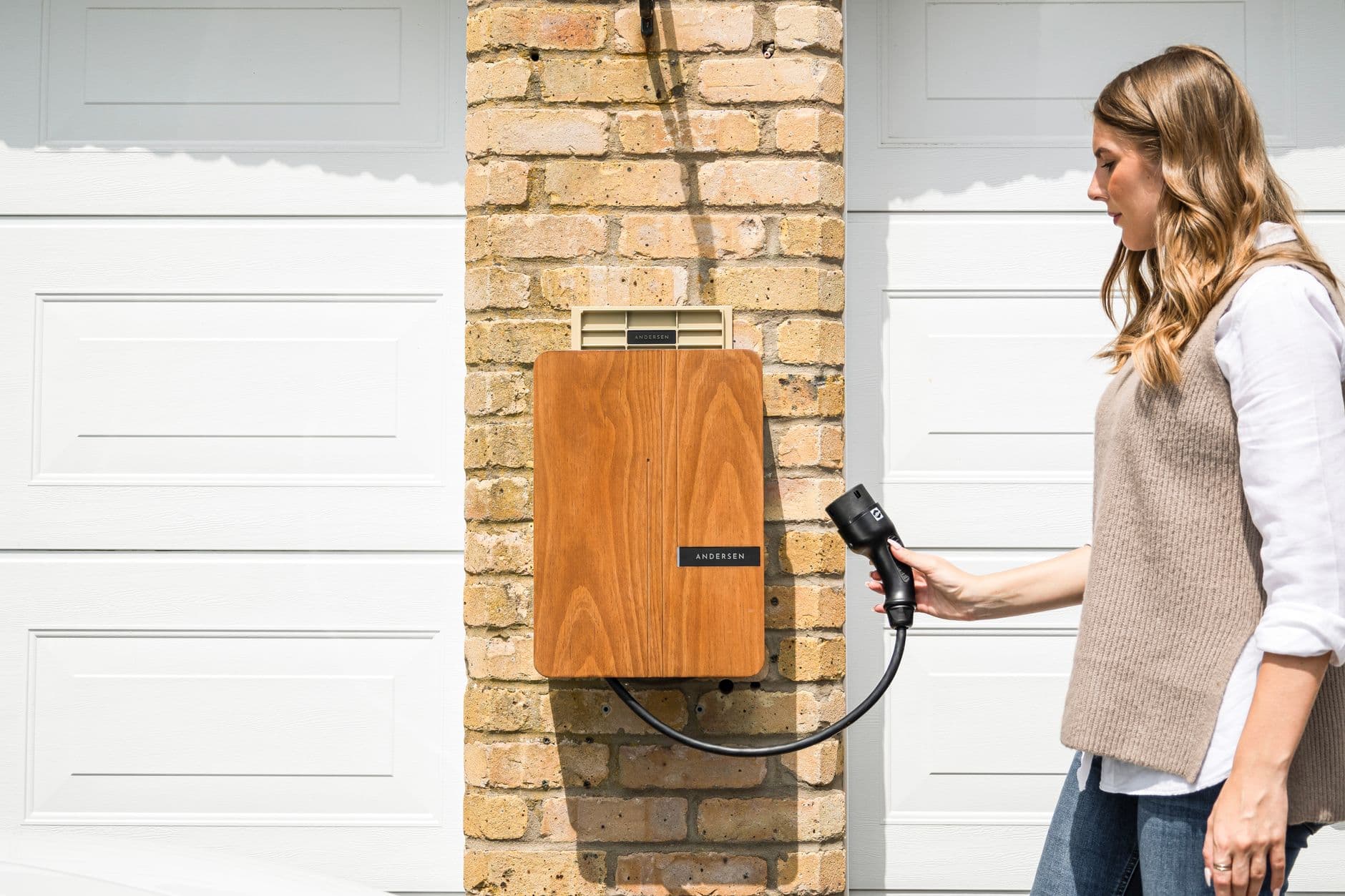
From charging power to connection and dynamic charging: what installing a home EV charger involves.
Home charging is more convenient and usually more cost effective than charging on the go. Before you have a charge point installed, it helps to know which choices you have: the type of charge point, the charging capacity, how it is connected to your installation and whether your consumer unit can handle that.
This guide brings those points together. We explain what dynamic charging does, when an upgrade of your connection may be needed and why correct protection and inspection are not a detail but the foundation of a safe installation.
Charging points differ mainly in charging capacity, expressed in kilowatts (kW). A single-phase connection charges more slowly than a three-phase one, which reaches higher capacities. Faster is not automatically better: what matters is that your car charges sufficiently overnight or during your solar hours.
The type also counts. Some charging points are simple, while others can communicate with your solar panels and your meter cabinet, which opens the door to smart and dynamic charging. Which capacity and type suit you depends on your car, your driving behaviour and your installation.
An EV charger gets its own circuit in the consumer unit, with a dedicated circuit breaker and the correct residual current device. This keeps charging separate from the rest of your installation and safely protected.
If your EV charger draws a lot of power and your consumer unit is already full, an upgrade of your supply connection may be needed. Whether that is the case depends on your current connection and your simultaneous consumption. We measure this during the site visit and tell you in advance whether an upgrade is required, so you are not caught by surprises.
With dynamic charging, the charging point automatically adjusts its power to what your home can still handle at that moment. If the dishwasher is running and the oven is on, the car charges more slowly for a while. When consumption drops, charging goes back up. This prevents your main fuse from blowing.
Smart charging can also follow your solar power: the charging point charges faster when your panels are generating a lot. This kind of control is linked to energy management, and it is exactly where a well-installed charging point makes the difference compared with a loose plug on the wall.
A charging point is a fixed installation with a considerable power rating. Correct protection with the right residual current device and circuit breaker is not a luxury. After installation, the system should comply with the applicable regulations.
A new or modified electrical installation requires an AREI inspection. We explain what is checked during this in our guide to the electrical inspection. Correct installation and inspection give you the certainty that you can charge safely and without worry.
We look at your meter cabinet, the cable route and the spot for the charging station, and measure whether your connection is sufficient.
You receive a proposal with the right type, charging power and any upgrade needed, matched to your car and installation.
We lay a dedicated circuit with the right protection and fit the charging point professionally.
The installation is inspected where required, and we show you how smart and dynamic charging works.
We assess your fuse box and the location for your EV charger and propose a safe, suitable solution. Request a site visit or quote.
