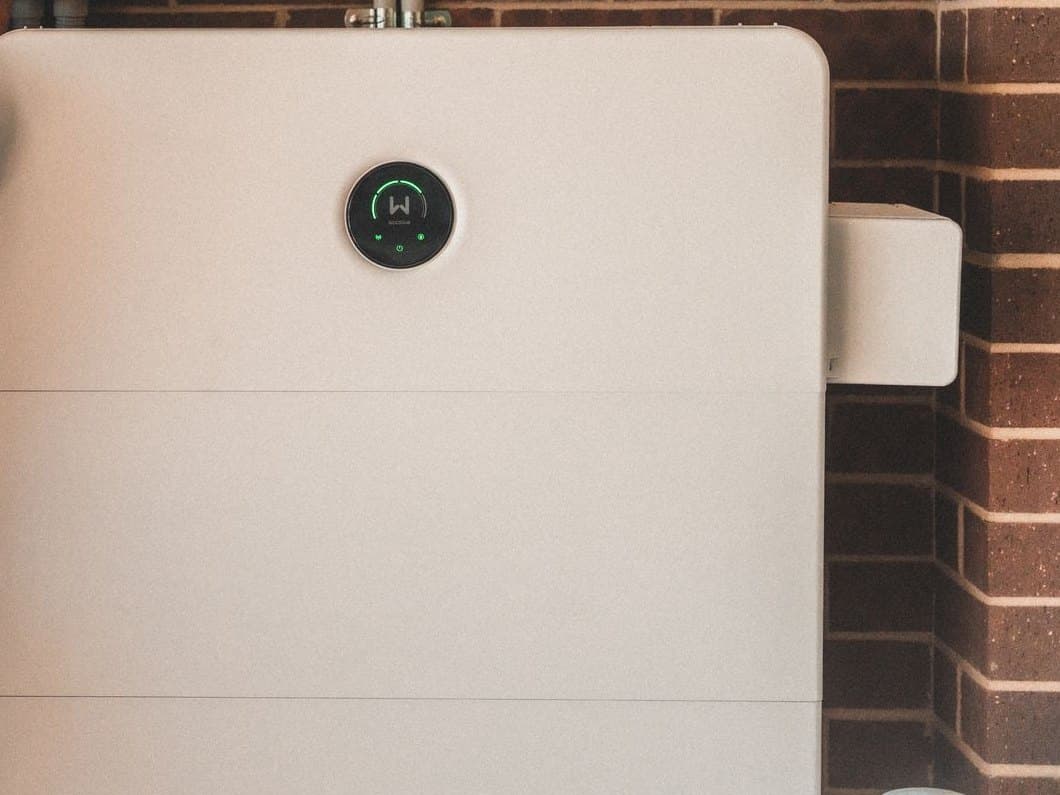
A home battery stores the energy your solar panels generate during the day, so you can use it later when the sun is not shining. Whether that makes sense for you depends on your consumption, your installation and how you manage energy during the day. We will look at that honestly with you.
Home battery
Installing and connecting a home battery
Since the reversing meter was phased out, you get more out of using your own solar energy. A home battery stores your surplus for later, matched to your installation and consumption.
What can we help you with?
 Rather speak to someone right away?0494 37 68 68
Why self-consumption matters more now
In Flanders the reversing meter is being phased out. If you have a digital meter, it no longer runs backwards when solar panels feed electricity into the grid: the electricity you draw and the electricity you feed in are recorded separately.
That is precisely why self-consumption is becoming more important: the more solar power you use yourself while your panels are producing it, the less you draw from the grid. With a home battery you store your surplus and use it later, instead of feeding it into the grid. The capacity tariff also rewards consumption that is spread out more evenly: smart control can help you avoid running all your high-power appliances at the same time.
How much you actually gain depends on your consumption, your installation and energy prices, and a home battery does not pay off for everyone. That is why we do not promise a fixed amount. Look into it carefully before you invest.
Who a battery could be interesting for
A battery is particularly useful if you generate a lot of energy during the day but use little at that time. By storing that energy, you use more of your own electricity later.
We do not promise a fixed saving or payback period. That depends on too many factors to put a figure on in advance. However, we clearly explain what a battery can realistically mean in your situation.
Self-consumption or feeding back
A simple comparison of what happens to your solar energy.
Without a battery
- Surplus goes to the grid
- In the evening you buy energy back
- No extra installation needed
With a home battery
- Surplus is stored
- In the evening you use your own energy
- Battery and space required
Our approach
01
Matched to your inverter
We check whether your current inverter is suitable or whether an adjustment is needed.
02
The right capacity
We choose the capacity based on your consumption, not on the largest model.
03
Safe installation
The battery goes in a suitable spot and is connected correctly to your installation.
Request a quote for a home battery
Briefly tell us your situation. We look at whether a battery suits your installation, and which one.
Frequently asked questions
- Do I need solar panels for a home battery?
- A battery is mainly worthwhile in combination with solar panels, because then you store the energy you generate yourself.
- Will my current inverter work with a battery?
- Sometimes yes, sometimes an adjustment or an extra inverter is needed. We assess that during the site visit.
- How much do I save with a battery?
- That depends on your consumption, your installation and energy prices. We give you a realistic estimate, not an empty promise.
- Is a home battery still worthwhile now that the reversing meter has been phased out?
- That is precisely why self-consumption becomes more important. As long as the meter ran backwards, you were effectively using the grid as free storage. Now that consumption and injection are billed separately, it pays more to store your solar power during the day and use it yourself in the evening instead of injecting it cheaply. Whether it balances out for you depends on your consumption, your panels and your tariff. We work it out for your own situation before you decide anything.
- How large should a home battery be for my solar panels?
- The right capacity depends on what you consume in the evening and at night and on what your panels generate in a day. A battery that is too large rarely fills up and you pay for it unnecessarily; too small and you miss out on storage on sunny days. We determine the size based on your metering data and your household consumption, not on a fixed recipe.
- Can a washing machine or dishwasher run on a home battery?
- Yes, as long as the battery and the inverter supply enough power for the peak of the appliance. Heavy consumers such as a washing machine, dishwasher or oven briefly demand a higher peak; a correctly sized installation absorbs that. During the design we take into account which appliances you want to run at the same time.
Home battery in your region
We work throughout Flanders: East Flanders, West Flanders, Antwerp, Flemish Brabant and Limburg. Not sure whether your address falls within our service area? Feel free to ask, and we will look at it together.
- East Flanders
- West Flanders
- Antwerp
- Flemish Brabant
- Limburg
Thinking about a home battery?
Request a quote or do the EnergieUpgrade Scan first.